Sewer & Wastewater

If the reoccurrence of a blockage does not clear up, a sewer camera inspection may be required. During the camera inspection the Town of Vermilion will run a camera down the service line through the cleanout access point in your basement. The camera is pushed through the line to the main, recording a video inspection of the interior of the sewer pipe.

If there is a blockage in the line, the blockage will have to be cleaned out by a plumber prior to the camera inspection to drain the standing water in the line so the interior pipe can be visible and inspected. The property owner will be responsible for the cleaning costs. If during the camera inspection the blockage is found in the portion of the service line that runs from the property line to the main line the property owner may be eligible for reimbursement of the cleaning costs.

If during the camera inspection, it is determined that a blockage exists anywhere along the line from the house to the main due to the property owner releasing hazardous, prohibited or restricted waste into the line then it is the property owner will not be eligible for reimbursement.

A property owner can request a sewer camera inspection at anytime, even if there has not been a backup. Contact the Infrastructure and Planning Services Department at 780-581-2415 to book an appointment.
Sewer lines that are damaged or cannot be cleaned may require a repair or replacement.

Responsibility of a Municipality 

The municipality will construct, maintain, and repair the service line from the property line to the main.

  • During a repair the municipality may have to remove the pavement, sidewalk, and/or landscaping to access the underground utility line.
  • After the repair, the area is filled with gravel or soil until it can be restored to its previous condition. This includes replacing underground sprinklers, lawns, planting beds, driveways, sidewalks, curbs, etc.
  • It is normal for the fill material to settle and sink below ground level before it can be restored to its previous condition.
  • Paving, concrete, and landscape work can only be done in warm weather (usually May to October) and will automatically be scheduled for you.
  • Once the landscaping is complete, it is the responsibility of the property owner to water and maintain until grass and plantings have rooted.

Responsibility of a Property Owner

The property owner will be responsible for the construction, maintenance, and repair of the service line from the house to the property line.

The wastewater treatment facility is a membrane biological reactor facility located on the east side of town. The treated sludge from the facility is reclaimed and used in non-agriculture industries. The quality of the wastewater discharged from the facility is monitored by Alberta Environment and all high quality treated effluent flows into the Vermilion River.

The wastewater system in Vermilion is a gravity-fed system. The service line from your home connects to the main at a downward angle allowing the wastewater to flow by way of gravity. Inside your premises, you will have a cleanout which is an access point on your service line that allows a plumber to clear debris if the line is clogged.

A sewer back up is caused by a blockage in the sewer line. If your sewer service backs up, immediately contact a local plumbing contractor. The plumber may be able to clean out any build-up or obstruction in the line, restoring your sewer service. The most common causes of a back up are tree roots, grease buildup, frozen lines, a sag in the line or a broken pipe, or debris.

Roots can easily infiltrate a clay tile sewer line and quickly fill up the pipe. Some tree roots can continue to grow even after a tree has been cut down to the stump. If the plumber finds traces of roots when cleaning out your line, give us a call and we can further assist you with a sewer camera inspection to identify the density of roots in the line.

Service lines made of PVC pipe are not as susceptible to tree roots. If your claytile service line is completely blocked with tree roots, we may recommend that you replace your service line with PVC pipe to prevent future tree root problems.

Fats, oils, and grease that are poured down the drain can clog sewer pipes leading to costly repairs. Store it don’t pour it, first cool and drain the grease into an old jar and place it in your household waste. If the plumber finds excessive grease when cleaning out your, give us a call and we can further assist you with a liquid digestive enzyme that breaks down the grease into water soluble nutrients. This is a temporary fix; continuous grease buildup in the line will result in replacement of your service line.

A grease interceptor (trap) is recommended for business that process grease, fats, and oils. The inceptor acts as a reservoir holding the wastewater and food solids that enter the trap. As the wastewater cools, the grease hardens, and the food solids settle. The wastewater is forced through the trap into the sanitary sewer system and the grease and food solids remain in the trap.

Early spring when temperatures fluctuate, storm drains and sewer mains are susceptible to freezing. The Town of Vermilion has a scheduled maintenance program to thaw these lines before they cause further problems. In particularly cold winters, shallow service lines can also freeze under driveways or areas with little snow cover to act as insulation, causing your sewer service to backup. We can assist you with thawing your line but there is no way to prevent a sewer line from re-freezing. Many sewer lines will re-freeze until the outside temperatures become more constant.

Service lines can shift and settle throughout the years causing the pipe to misalign or sag. This can cause reduced flow and even a blockage in the service line. If the plumber cannot clear the blockage in the pipe, give us a call and we can further assist you with a sewer camera inspection to identify if there is misalignment or sag in the line.

Flushing or dumping hazardous, prohibited or restricted waste into your service line can cause an immediate backup, especially if tree roots have already infiltrated the line.

Items that cannot be dumped into the sewer system:

  • hazardous, prohibited or restricted waste
  • feminine hygiene products
  • paper towels
  • baby wipes
  • diapers
  • prophylactics
  • syringes

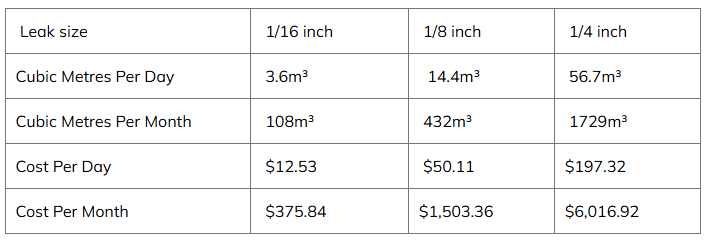
Checking your home several times a year for a leak and making repairs quickly can save you from an unexpected high water bill. Local hardware stores can offer helpful suggestions for repair methods and replacement options.

To check for a leak in your home, take your first reading from the meter right before you go to sleep at night and then take a second reading first thing in the morning. Compare the results to see if there was any water consumption during the night. If the register has not moved, you have a relatively watertight home. If it has moved, you may have a leak and you should start checking toilets, faucets, hose connections, hot water tanks, and water softeners. Often a new washer is all you need to repair a leaky connection.

Toilets are the most common source of a water leak. A small leak in a toilet can use 30m3 of water per month and add approximately $100 per month to your utility bill. To check your toilet for a leak, place a few drops of a dark food colouring into the toilet tank (do not flush). If any trace of colour appears in the bowl within an hour, you have a leak.

Other causes of a leak in a toilet can occur at the flapper valve where a slight amount of scale or corrosion can build up. The water level in the toilet tank may also cause a leak if it is set too high, causing it to leak into the overflow pipe. Adjust to the float arm to keep the water below the top of the overflow pipe.

You can also check for a leak by checking the low flow indicator on your meter. If you are sure there is no water running in your home and the low flow indicator is spinning, then there may be a leak outside of your home. Turn off your shut-off valve then check around the outside of your home for a possible leak.

Older appliances that are not as efficient as newer models can have an impact on the amount of water you use in your home i.e. water softeners stuck in regeneration mode are a common cause of high water consumption and automatic humidifiers that are connected to furnaces. If your system has a built-in humidifier, check it regularly.

A leak in a service line can be difficult to detect and costly to repair. Determining who is responsible for the repair of a leak is determined by the location of the leak in the line. If the water leak is located in-between the curb stop and the main, then it is the responsibility of the municipality to repair the leak. If the water leak is located between the curb stop and the home, then the property owner would be responsible for the repair.

The municipality will construct, maintain, and repair the service line from the curb stop to the main.

  • During a repair the municipality may have to remove the pavement, sidewalk, and/or landscaping to access the underground utility line.
  • After the repair, the area is filled with gravel or soil until it can be restored to its previous condition. This includes replacing underground sprinklers, lawns, planting beds, driveways, sidewalks, curbs, etc. 
  • It is normal for the fill material to settle and sink below ground level before it can be restored to its previous condition. Paving, concrete, and landscape work can only be done in warm weather (usually May to October) and will automatically be scheduled for you. Once the landscaping is complete, it is the responsibility of the property owner to water and maintain until grass and plantings have rooted.

The property owner will construct, maintain, and repair of the service line from the curb stop to the house as well as all the pipes and fittings within the home, including the shut-off valve.

  • During a repair, the water supply to your home must be shut off at the curb stop.
  • We recommend keeping the taps closed during a repair to prevent flooding when the water is turned back on.
  • Please contact the Utilities Department at 780-581-2412 to book an appointment.

Sign up to our Newsletter

Stay up to date on the Town's activities, events, programs and operations by subscribing to our news and notices.